Theatre Before the Proscenium Frame
Theatre before the proscenium frame reveals how open, central, and thrust stages shape sightlines, actor movement, and the audience’s attention.
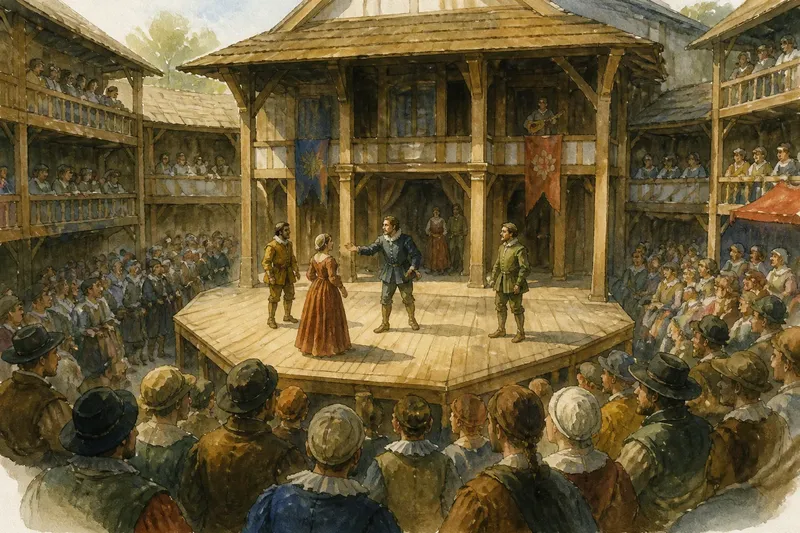
Theatre before the proscenium frame organized spectators around open playing areas rather than behind a single front-facing view. The difference matters: where you sit can shape which faces you see, how actors move, and whether the audience watches as one group or from several angles.
Before the frame
A proscenium is the architectural frame that separates a stage from the auditorium, often making a performance appear like a picture. It encourages a clear forward view, while scenery can conceal backstage activity. But theatre did not begin with that arrangement, and performance traditions did not follow one universal path toward it.
Spaces for performance have included open-air gathering places, temporary platforms, courtyard stages, and arenas. Their forms varied across societies and periods. The useful questions are spatial: where actors perform, where spectators sit or stand, and whether both groups share a field of attention.
In ancient Greek theatre, performances took place in large open-air settings. A circular dancing area, commonly called the orchestra, lay before a built background structure, while spectators occupied rising banks around the playing area. The action remained open to the surrounding space rather than enclosed within a proscenium picture.
In Elizabethan public theatres, a projecting platform extended into a yard surrounded by galleries. Viewers watched from several sides, and some stood close to the platform. In medieval European settings, religious plays could use multiple stations across a shared area, with spectators shifting their attention between them. These arrangements differed, but each organized looking without placing all the action behind a frame.
Three stage layouts
Stage-layout terms describe the audience’s position relative to the acting area. A venue can combine features or adapt a layout for a particular production.
- End stage: Spectators face one side of the playing area. A proscenium is a familiar version, but an end-stage arrangement need not have a decorative frame. The shared forward view can support concealed scenery changes.
- Thrust stage: The platform extends into the audience, which sits on three sides. Actors can approach different groups, but blocking must keep scenes legible from several angles.
- In the round: Spectators surround the acting area. A performer’s back may face some viewers as the scene turns toward others, making the audience’s changing perspective part of the event.
Arena and thrust layouts are sometimes grouped under “open stage,” but they are not the same. An arena has spectators on all sides; a thrust has them on three. Both lessen the sense of a distant picture, while creating distinct sightline and movement challenges.
Open-stage sightlines?
Why can a face be hard to see?
In an arena, actors change orientation, so one spectator may see a profile while another sees a face. On a thrust stage, a performer or set piece can block a view from the side. Before choosing a seat, check the venue’s seating plan for restricted views and consider whether raised platforms might interrupt your line of sight.
Why do actors turn their backs?
Facing one section means turning away from another when spectators sit on several sides. That turn can direct attention or make a scene feel shared rather than displayed. Notice whether the staging shifts focus over time, giving different sections a view of faces and gestures.
How can movement seem hard to follow?
Without one front, entrances and exits can occur at several edges, and actors may cross through the audience’s field of view. Follow exchanges of attention rather than expecting every action to face you. Repeated paths and pauses can help establish where an important moment is happening.
Why might scenery seem sparse?
Large fixed scenery can block views when spectators look from several directions. A production may establish place with portable objects, suggestive details, or lighting instead. Consider what a small object or repeated gesture contributes before treating the lack of a realistic backdrop as an absence of design.
Acting across space
When actors perform close to spectators, small changes in posture, pace, and gaze become easier to notice. In a large, front-facing house, gestures may need to read from a distance. Around a central platform, a slight turn can change who receives a look or a line. Proximity does not simply make acting more intimate; it asks performers to distribute attention across a room without one shared front.
Say you attend an invented family drama on a thrust stage and sit beside one edge of the platform. At the start, the actors cluster at the far end, so their faces are partly hidden from you. They then spread out and turn toward different sections as the argument grows. You can now see more expressions, but the exchange feels less private: the staging presents the dispute to the room without changing the dialogue.
Audience behavior shifts with the layout, too. A proscenium can encourage spectators to look through a frame and treat the stage as a separate world. In an arena, viewers may see one another react or hear laughter travel across the room. That visibility can create a sense of shared attendance, though it does not mean the production invites direct participation.
Choosing and reading seats
What does a thrust stage allow?
A thrust brings actors closer while giving some scenes a primary direction. It can make movement feel as though it passes among spectators, but blocking must keep dialogue and expressions available from the sides. Watch how performers turn when a conversation shifts.
Does an arena require participation?
No. “In the round” describes the audience’s position, not a requirement that spectators speak or act. A production can maintain a clear boundary between players and viewers even when they share close physical space.
How should I choose a seat?
Check the venue’s seating plan and read any notes about restricted views, especially when the stage is surrounded on several sides. If you can choose, decide whether you prefer a stable frontal perspective or a closer view that changes as actors move.
Space shapes attention
Before the proscenium frame became a familiar convention, performance already used open-air circles, projecting platforms, shared courtyards, and other arrangements. These spaces did more than provide different backdrops: they shaped which faces could be seen, how actors shared attention, and whether spectators watched together or from competing angles.
When you watch theatre before the proscenium frame, or a contemporary production that uses an open arrangement, begin by locating the playing area and noticing where your view changes. A turn toward one audience section, an entrance from an unexpected edge, or a deliberately exposed pause can reveal how the room shapes the encounter.