A First Dance Performance: Watch the Space Between
A first dance performance becomes easier to follow when you track spacing, pathways, and groupings, giving your attention a clear place to rest.
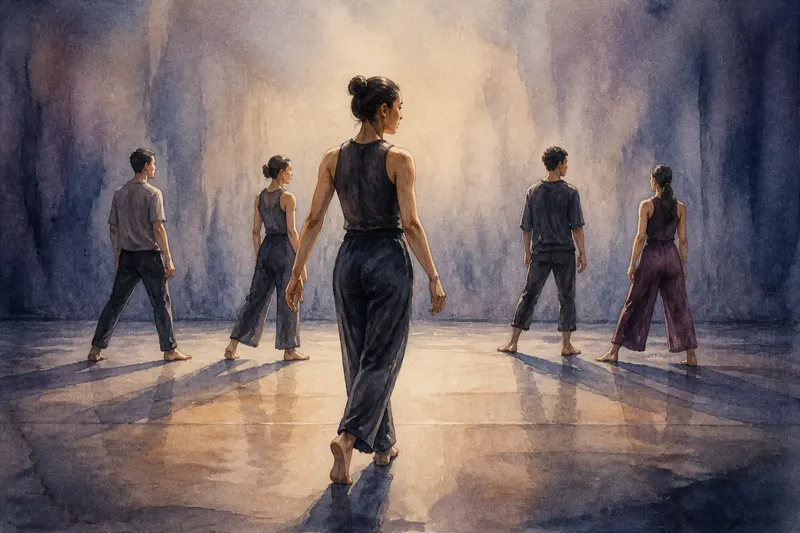
At a first dance performance, the distance between two performers can tell you where to look before you recognize a single step. Follow those distances, pathways, and groupings, and the stage begins to read as a changing map rather than a puzzle of movements to decode.
Imagine you have tickets to a small theater’s evening dance program. You know little about dance vocabulary, and the choreography includes both a soloist and a group. Instead of trying to name every movement, you decide to watch how bodies arrange themselves in space. That simple choice gives you a thread to follow from the opening image to the final one.
Choose a viewing thread
Dance presents several things at once: bodies move, music or silence shapes timing, and the stage changes as performers meet, separate, and shift direction. A first-time viewer may feel pressure to interpret each gesture immediately. You do not need to. A practical viewing thread is to notice three spatial questions: Who is near whom? Where does movement travel? How does the group form or dissolve?
These questions describe visible choices without claiming to explain the choreographer’s intention. A pair standing shoulder to shoulder might suggest agreement, but it might also be a starting arrangement chosen for its visual balance. Keep observation and interpretation distinct: first notice what happens, then consider what it might make you feel or expect.
In the imagined performance, the curtain opens on five dancers spread across the stage. You notice that one stands downstage, closer to the audience, while the others occupy a loose line farther back. The front performer is easy to see, but the arrangement also makes the empty areas between bodies visible. You do not yet know who matters most. You simply register the opening map.
Read the distances
Distance is more than a gap measured by the eye. It can change the sense of a relationship. Two dancers close together may seem connected, while a similar pair separated across the stage may seem to address each other across a divide. Those are possible impressions, not fixed meanings; the music, posture, and movement can shift them.
Watch for changes rather than trying to assign a symbol to every gap. Does a pair draw closer gradually, break apart sharply, or remain at the same distance while turning? Does one dancer approach while the other stays still? A change in spacing can make a small action feel consequential without requiring a dramatic gesture.
In this hypothetical scene, the front dancer walks toward the group. The others do not move to meet them. As the gap closes, one performer steps aside and opens a narrow passage. You might read the passage as welcome, reluctance, or simply a route through the formation. The observable point is clearer: the group changes its shape to make room, while its members do not gather around the newcomer.
That distinction helps you keep watching. After the newcomer passes through, note whether the gap closes behind them or stays open. If it remains, the empty space may continue to draw attention even after the dancers have moved away. You can ask what the stage makes prominent without deciding what the empty area “stands for.”
Trace the pathways
A pathway is the route a dancer takes through the stage. It may run straight across, curve around another body, circle a partner, or stop short of a destination. Following the route is often easier than following the exact footwork, especially when several performers move at once.
Use the stage’s visible landmarks. The center, corners, wings, and front edge give you reference points. Notice whether someone travels from the back toward the audience, crosses from one side to the other, or returns to a place already visited. The route can make a performer seem to advance, retreat, evade, or revisit, though the choreography need not tell a literal story.
In the invented performance, the soloist crosses diagonally from upstage left toward downstage right. The group follows the same diagonal, but each dancer starts later than the one before. Rather than trying to catch every movement, you track the route and the staggered departures. The repeated pathway makes a chain across the stage; the delayed starts make that chain appear to travel through time.
Then the soloist turns back before reaching the front corner. That interruption changes your expectation. The pathway had suggested arrival, but the turn sends the dancer back toward the center. You can notice the reversal without deciding whether it means refusal, hesitation, or a change in musical phrasing. The choreography gives you a visible event; interpretation can remain open.
When routes overlap, watch where they cross and whether performers avoid, meet, or pass through one another’s paths. A crossing can create a brief point of focus, like two lines intersecting on a map. If you lose track of an individual, follow the route of the whole group instead.
Notice groupings
Formations are the shapes dancers make in relation to one another. A line, circle, cluster, pair, or scattered arrangement can appear and dissolve quickly. You do not need to know formal terminology to recognize these patterns. Describe them in ordinary words and notice how long they last.
Ask whether a formation is symmetrical or uneven, tight or loose, stable or shifting. A centered group may feel settled; a formation weighted to one side may make the opposite side feel exposed. Again, these are ways to describe an effect, not a code with one correct translation.
In the hypothetical performance, the five dancers gather into a compact cluster. The soloist stands just outside it, facing inward. The cluster rotates slowly while the soloist remains in place. You might first notice the contrast: one body stays still while several bodies turn. Then, as the cluster opens into a shallow arc, the soloist moves into the gap. The group’s arrangement changes who is visually included, even though the cast has not changed.
Now watch how long the new shape holds. A formation that lasts can let you examine its balance and relationships. A shape that appears only briefly may work more like a punctuation mark. If you have time to look at the whole stage, take it; if action is moving quickly, settle on one relationship, such as the soloist and the nearest dancer.
Keep a light note
You can make a short mental record between scenes or after the performance. Keep it concrete: “five in a line,” “soloist crosses diagonally,” or “pair separates while group stays still.” Avoid trying to write a full interpretation during the dance. A few observed changes are enough to help you recall the work afterward.
For the imagined evening, your notes might show a progression: a spread-out opening, a passage made through the group, a repeated diagonal crossing, then a compact cluster that opens around the soloist. You have not translated the dance into a plot. You have noticed how its spatial relationships changed, and that sequence can give you something specific to discuss.
If you do want to interpret, connect your thought to the evidence. For example: “The group repeatedly closes around the soloist, so I felt the soloist was being contained.” That statement marks the feeling as yours and identifies the arrangement that prompted it. Another viewer might experience the same cluster as shelter or support. Difference in response does not erase what both of you saw.
Questions to carry
Where should I look when everyone moves?
Start with the largest change in spacing or direction, such as a group splitting or one dancer crossing the stage. If the movement is dense, choose one performer and follow their route until the formation settles.
Do formations have fixed meanings?
No single shape has a universal translation. A circle, line, or isolated figure can create different impressions depending on timing, gesture, music, and what comes before or after it.
What if I miss a movement?
Let it go and rejoin the dance at the next clear change in position or grouping. Spatial patterns often recur, so following the next route or formation can restore your bearings without requiring you to reconstruct every step.
Should I read the program first?
A program can provide names, production details, or the choreographer’s framing, which may be useful if you want that context. You can also watch first and read afterward, preserving your own initial observations before you encounter another description.
Leave room for change
Near the end of the invented performance, the dancers return to a spread-out arrangement like the opening one. This time, however, the soloist stands among them rather than in front. You can compare the two images: similar spacing, different placement. That small shift gives your viewing thread a satisfying point of return without requiring a definitive explanation.
The result of this imagined visit is not expertise in dance vocabulary. It is a more attentive experience: you have followed who approaches, which routes recur, and how a group makes or removes room. At your first dance performance, watch the space between as a visible part of the choreography, then let your interpretation grow from what you actually saw. If a later viewing reveals a new pattern, your first observations still count; they gave you a place to begin.